Magnetosphere
Quasi real-time determination of the 2D Magnetosphere
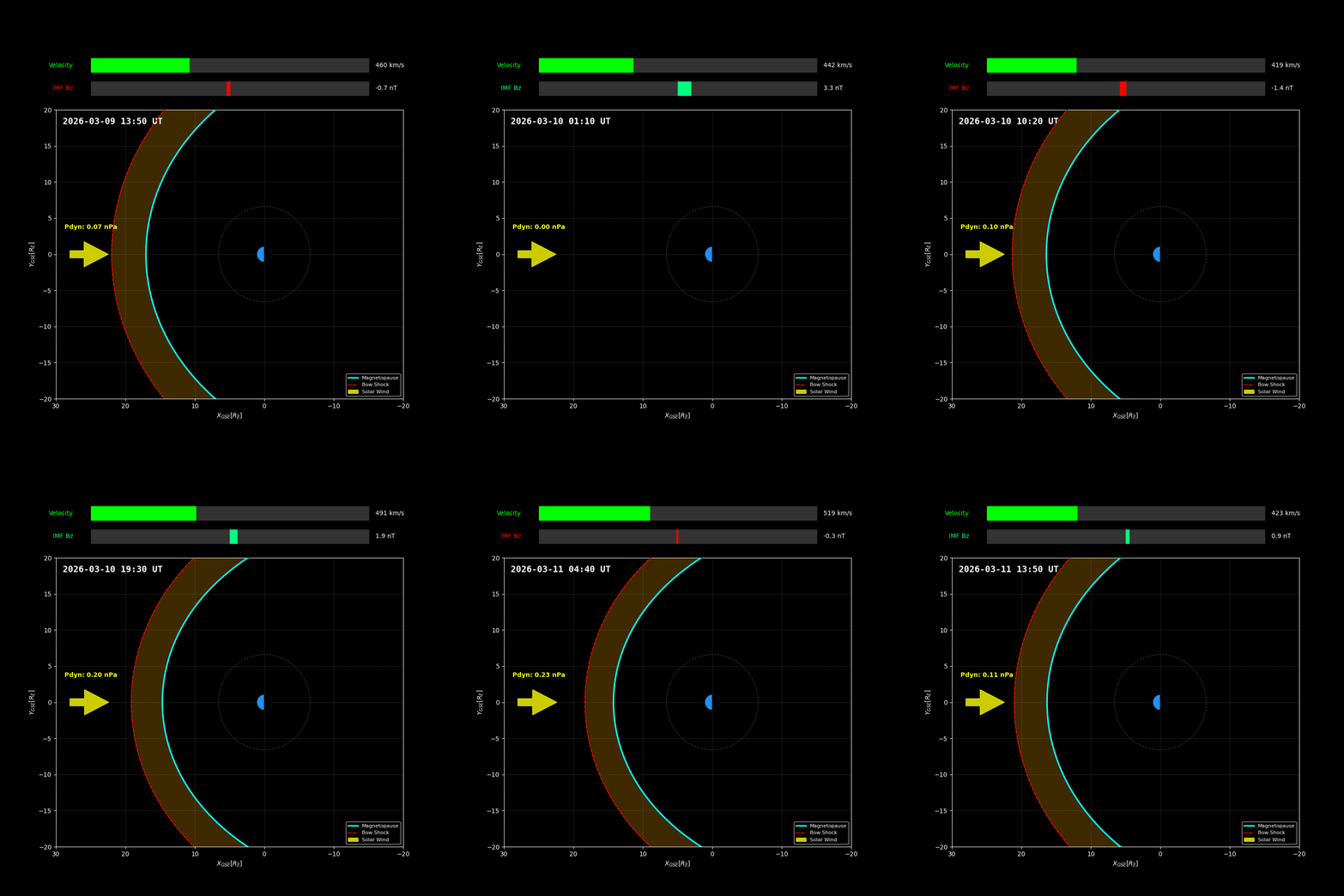
The global topology of the Earth's magnetosphere is modeled in real-time using in-situ solar wind parameters measured at the Lagrangian point L1 by the ACE satellite. The system calculates the position and shape of the two primary plasma boundaries—the magnetopause and the bow shock—providing a continuous monitoring of the terrestrial magnetic shield's response to solar activity.
We implement a semi-empirical approach based on the model developed by Shue et al. (1998), which defines the magnetopause surface using a functional form dependent on the solar wind dynamic pressure ($P_{dyn}$) and the northward/southward component of the interplanetary magnetic field ($B_z$). This allows for the identification of magnetospheric compression events, which are critical for the safety of geostationary satellites.
The bow shock position is derived through magnetohydrodynamic (MHD) relations, specifically accounting for the magnetosonic Mach number ($M_{ms}$) of the upstream flow. By calculating the sound speed and the Alfvén velocity from SWEPAM and MAG instruments data, the system estimates the standoff distance of the shock front. This calculation employs the Rankine-Hugoniot jump conditions to characterize the transition of the solar wind from a supersonic to a subsonic regime within the magnetosheath.