Parker's spiral
This module is aimed at providing a quasi real-time numerical reconstruction of the actual state of the interplanetary Parker's spiral.

To this end, we developed a new approach called RIMAP — Reverse In-situ data and MHD Approach. The plasma parameters in the inner boundary at 0.1 AU are derived directly from the in-situ measurements acquired at 1 AU by ACE, by applying a back-reconstruction technique to remap them into the inner heliosphere. This is done by using the Weber and Davies solar wind theoretical model to reconstruct the wind flowlines.
The plasma is then re-propagated outward by running a MHD numerical simulation based on the PLUTO code. The simulation is carried out in 3D, but final results are representative only of the plasma conditions (speed, density, and magnetic field) on the ecliptic plane, because no information on these parameters are currently available out of this plane.
In-situ Data Preprocessing for MHD Input
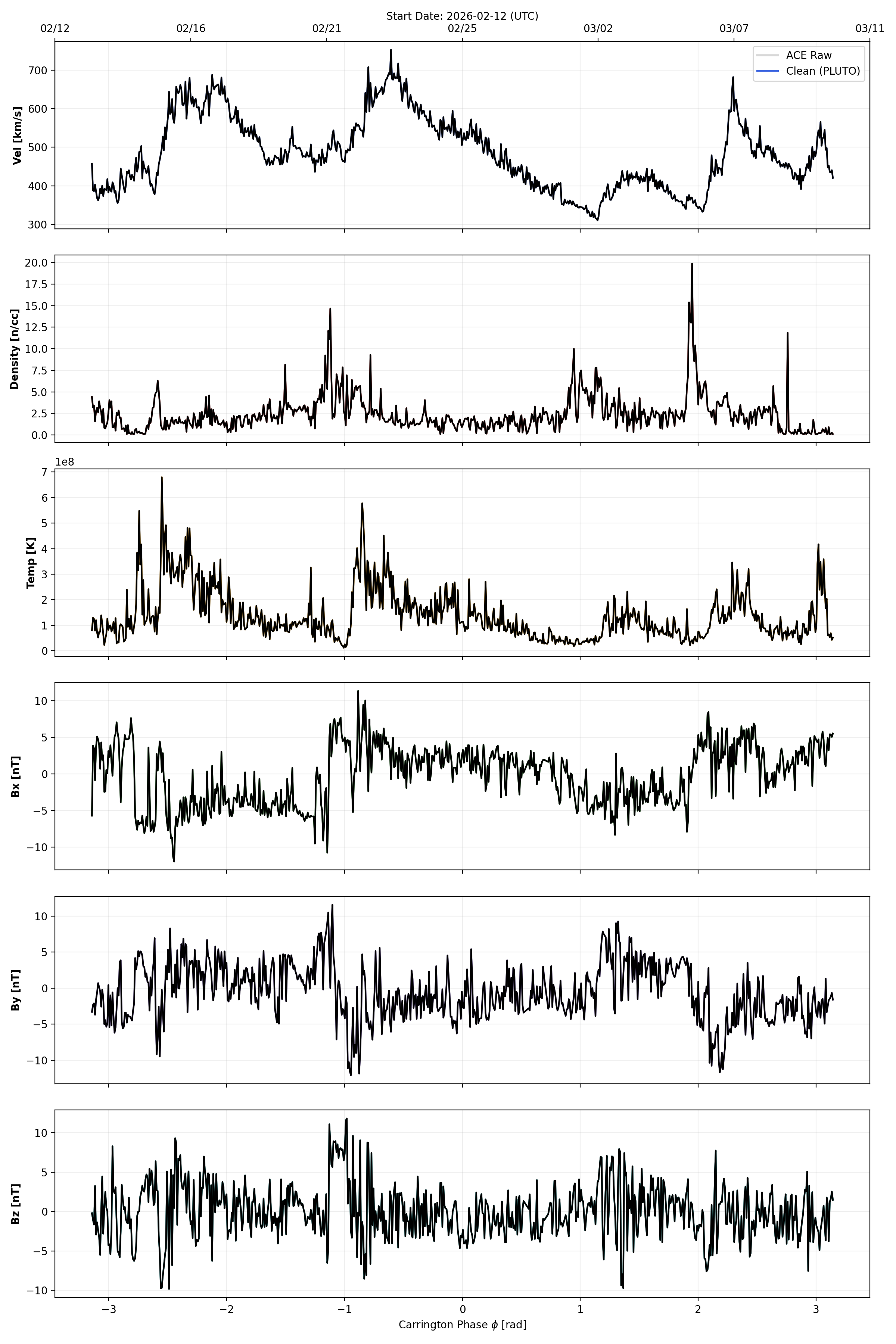
This multi-panel plot illustrates the data cleaning and preparation process required to initialize the RIMAP (Reverse In-situ data and MHD Approach) model. It provides a comparative view between raw spacecraft measurements and the processed inputs used for numerical simulations:
- Data Comparison: The charts display a comparison between the ACE Raw measurements (light gray) and the Clean (PLUTO) data (colored lines), filtered and prepared for the PLUTO MHD code.
- Physical Parameters: The panels show primary solar wind variables (Velocity, Density, Temperature, and Magnetic Field components Bx, By, Bz).
- Temporal Reference: Data is plotted against UTC time (top) and the Carrington Phase φ (bottom), covering nearly a full solar rotation.